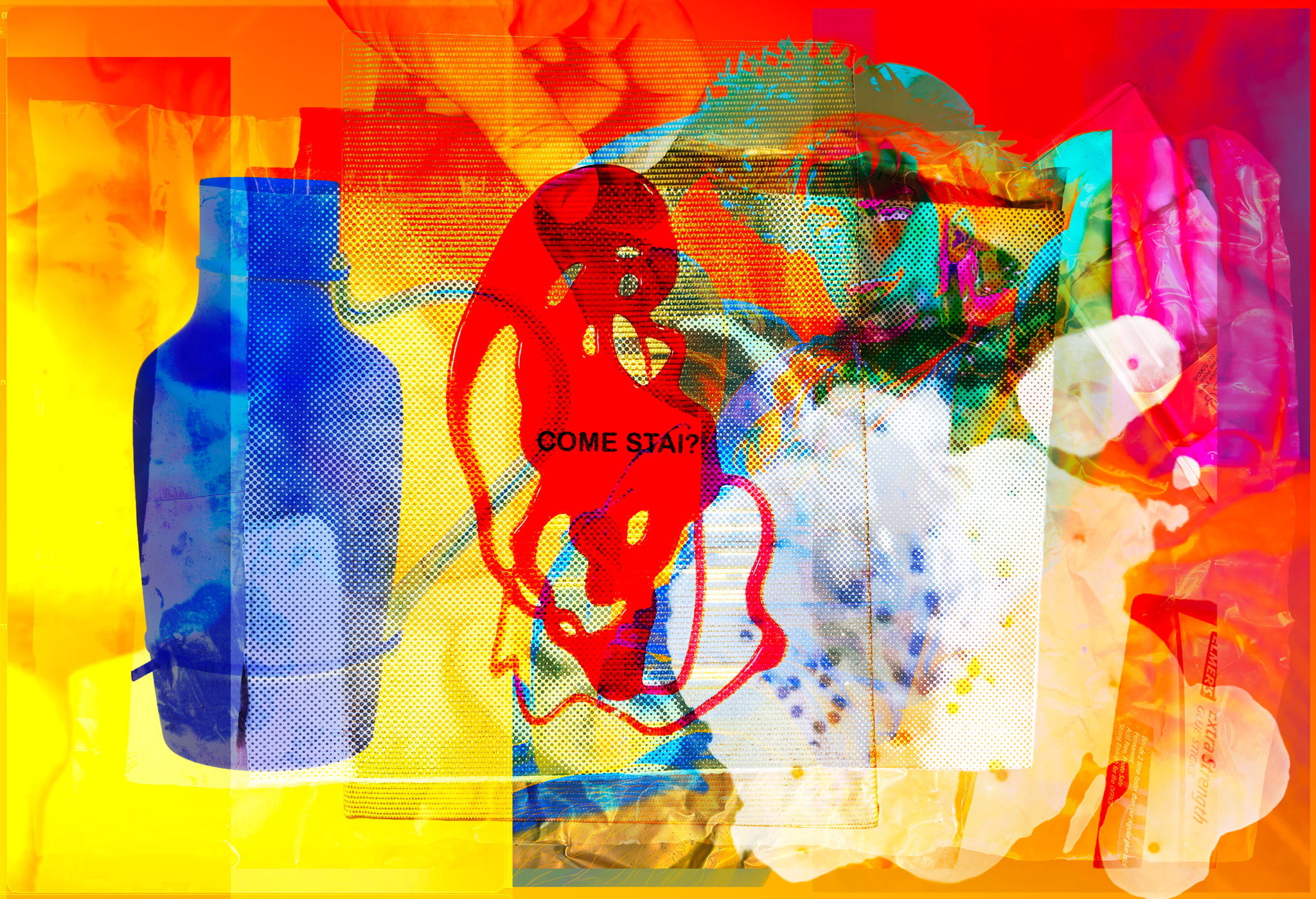

Collage, digital color print, 13 x 19 inches

Oh Color—fugitive color—overlapping, chaotic, excessive. Splatter and spill.
When I worked as a creative director, and before that as an aspiring one, I worked with a lot of people who would gush over Philip Johnson’s Glass House. But his ecstasy for fascism, literally and aesthetically, always disturbed me. The fantasy of transparency, restraint, and control feels less like openness than surveillance. Minimalism too: a butch hetero nightmare, material form fabricated from the neck up. Judd was sexy, but not in a fuckable way—cold, calculating, like a black turtleneck in a beige pantsuit. Cool. Aloof. No room for bodily fluids. Everything drained of blood.
Color is imperative to my work because it resists closure. Fascism depends on visual order—legibility, discipline, the fantasy of whiteness as neutrality. Hence all that black, and beige, and Pantone whiteness. Color undermines that fantasy. Queer color. It refuses to behave. It stains, overlaps, and exceeds its boundaries. An open, humanistic society cannot be imagined in monochrome. Whiteness—whether aesthetic, ideological, or racialized—operates by erasure.
Even the Greek white marble body is a lie. Those bodies were once covered in color—Asian, excessive, unstable, difficult to control. Color was worn away to fabricate foundational ideals of beauty and hierarchy. Under the surface of those cold Anglo-Saxon ideas beats a full, blood-red heart. Why suppress it? Why not unleash it—heat, lust, vitality?
Still sleepy in my morning art history lectures back in college, I remember when Jacob Wrestling the Angel by Paul Gauguin flashed onto the screen in the lecture hall and the stage lit up with an explosion of color. Jane Hammond—the artist and, back then, my teacher—talked about the painting and about a memory of hiking with her mother in the north of France, following the landscapes and spaces of great modernist painters, including Gauguin. They met an old woman selling cider from her farm, who recounted how her grandmother knew Paul Gauguin, whom she used to sell cider to, and how he would get drunk and try to kick her chickens. Sloppy, fantastic life—an inebriated tale of Paul being human. I’ll never forget that painting. It is one of my favorites.
Everyone loves to love Jasper Johns, and rightly so, but his restraint keeps the body at a distance. That body of grey paintings and drawings always felt like an obfuscation, an opacity that seemed to keep the world at bay. Rauschenberg, on the other hand, made more room. He transgressed materials and methods. He allowed eruptions, accumulations, ejaculations of color. Rauschenberg’s ROCI project, in particular—its international residencies, its openness to local materials and peoples, its vivid prints and combines—absorbed the detritus of experience. Loving, broken, ordinary life enters the work.
The collage I made today comes from that lineage. I take inspiration from everywhere: from bodies and digital artifacts I’m bombarded with across multiple platforms; from the words and worlds of Gaetano Pesce and Matthieu Blazy; from Come stai? (How are you?); from the idea that layers of color are alive. The collage doesn’t resolve. It doesn’t tidy itself up. It holds joy, excess, contradiction. It insists on pleasure. Sexual, sensual pleasure. It is a condition for being human. Refusal of aesthetic restraint. Where a queer, fugitive and joyful life is allowed to breathe.