I grew up in New Jersey in a household where things regularly fell apart. There were periods when eviction seemed possible, arguments could turn physical, and certainty was in short supply. Drawing became a way to make sense of the world. Making things gave me a measure of control over circumstances that often felt beyond my control.
Any excuse to get out of the house was a welcome one, so when I met one of the women from my church who was a potter, I asked to become her apprentice. I worked with her for eight years, learning about Anglo-Japanese pottery methods. Mixing clay, and glazes, building and firing Raku kilns, and showing up each day to make something. Those lessons have stayed with me. My understanding of art begins with materials and the accumulated knowledge of making. Each of the materials I work with; ceramic, painting and the collision of those materials into assemblage, carry their own histories and possibilities. I like to follow those materials where they lead.
In 1992 I began a daily drawing practice that continues today. For more than three decades I have filled sketchbooks with drawings of friends, strangers, artists, lovers, subway riders, and chance encounters. These drawings have become an archive that I continually return to. Images disappear for years and reappear in unexpected forms. A quick sketch made on a train may later emerge in a painting, a print, or a ceramic sculpture.
Growing up gay in the 1980s, including a period spent in conversion therapy, left me aware of how easily people, stories, and identities can be pushed out of view. Living in New York during the years shaped by AIDS activism, queer nightlife, and rapid cultural change reinforced that awareness. My work often begins with fragments—drawings, photographs, overheard stories, historical documents, devotional objects, family histories, or cultural myths. Through repetition, layering, drawing, and firing, these fragments are transformed into something new.
I think of many of my paintings and sculptural assemblages as artifacts. Figures emerge and disappear. Images are obscured, scratched away, printed over, or buried beneath other marks. Ceramic forms function like relics, and ex-voto offerings. Meaning accumulates through the process of making rather than through illustration.
My work is shaped by an interest in survival, transformation, and repair. I am drawn to the ways people construct identities, communities, rituals, and stories from incomplete materials. Whether working with clay, paint, printmaking, or assemblage, I approach the studio as a place where fragments can be accumulated and given another life.
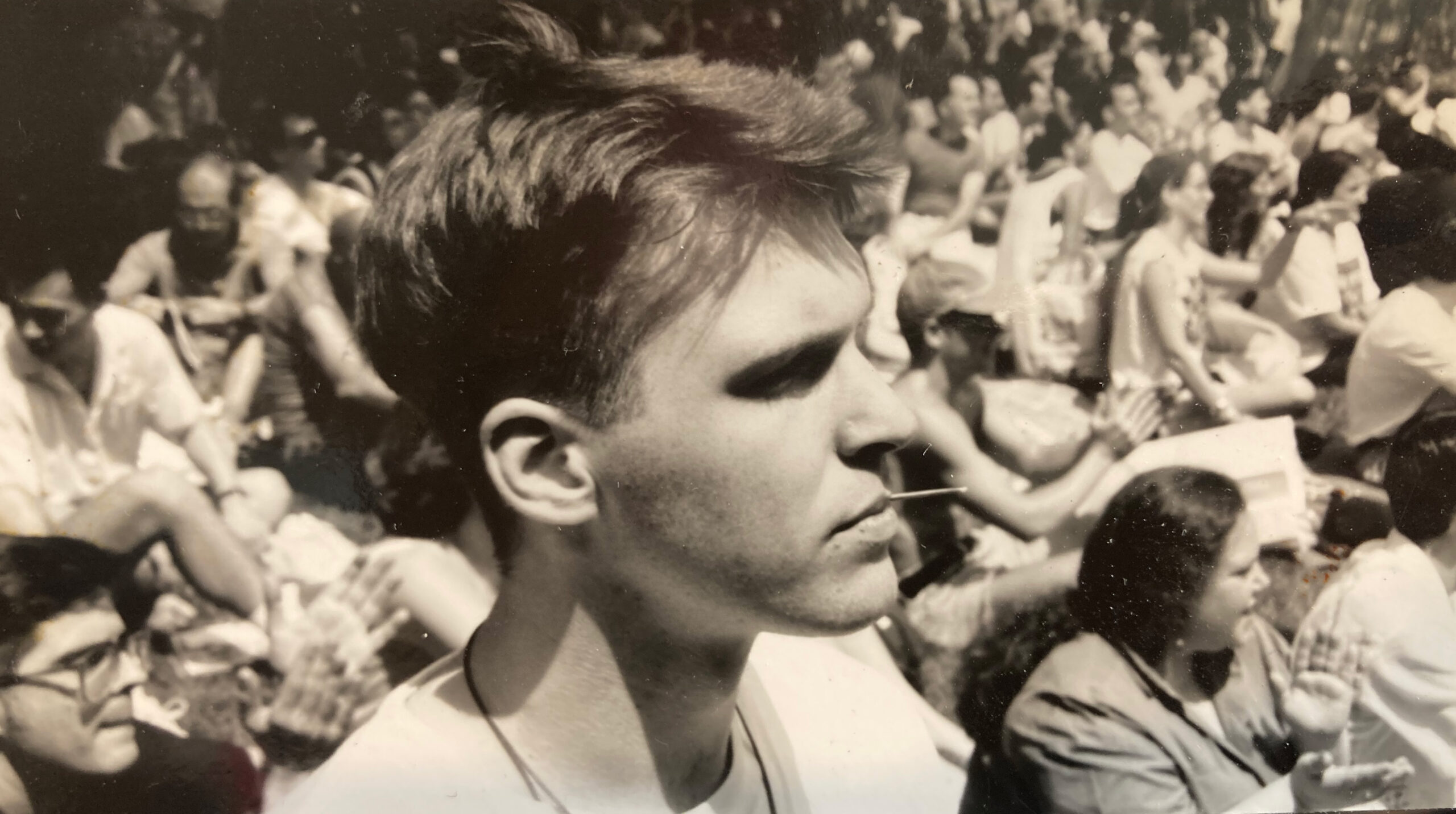 Union Square Park, Gay Pride Rally, photographed by Ken Tisa, 1991